


This article covers:
- The background of the new tax regulations
- The general uncertainty caused by rumors, irrelevant, and unverified information spread by foreign print media and so-called “influencers” on social media platforms and YouTube
- Examples to help calculate potential tax amounts
The Topic: Taxation of Foreign Income
As is well known and the subject of heated debate, the government plans to introduce new rules (beginning in 2024) for the taxation of income earned by foreigners staying in Thailand for more than 180 days and remitted to Thai accounts. The current lack of information has led to frustration and uncertainty among foreign retirees.
Today, we aim to address the situation especially for pensioners, as taxation for other foreigners—such as employees, digital nomads, dividend recipients, long-term visa holders, and investors with local income—is already clearly regulated. While the official announcement was made in 2023, there is still no clear guidance from the authorities on how taxpayers should be classified, how much tax should be due or how double taxation agreements shall be taken into account (status October 2024). This delay is largely due to the fact that the relevant government agencies are still reviewing the details and procedures.
The Trigger: “Thailand Loophole”
What is driving this new regulation on the taxation of foreign income? Thailand aspires to become a full member of the OECD (Organisation for Economic Co-operation and Development), which requires compliance with certain tax standards. One such issue is the so-called “Thailand tax loophole,” which has allowed tax-exempt income transactions. To align with OECD requirements, Thailand must address this loophole.
For example, in 2020, a Thai citizen transferred a large sum of money to a foreign bank account, such as in Singapore, where the money remains for at least 12 months and generates dividends. If the funds, including interest, are transferred back to a Thai account within the same year, taxes would be due. However, if the transfer is delayed until the following year or later, no taxes would be owed. This loophole is one of the barriers to Thailand’s full membership in the OECD.
The new regulation on foreign income tax aims to close this loophole, affecting not only Thai citizens working abroad but also foreigners living in Thailand. This has caused significant concern among foreign retirees, some of whom are now considering leaving Thailand or relocating to neighboring countries due to tax uncertainty. Others, who had planned to move to Thailand, invest in property, and enjoy its affordable lifestyle, are reconsidering.
Rumors and Misinformation
In recent months, numerous articles, YouTube videos, and even TV reports in Thailand and abroad have spread misinformation, adding to the confusion. Instead of providing clarity, these sources have often fueled further speculation with incorrect assumptions and alleged insider information.
For those closely following the issue and familiar with the situation in Thailand, the advice is clear: stay calm. It will take time before the tax regulations are clarified, as decision-making processes in Thailand are slow and subject to change. Avoid rushing to apply for a Taxpayer Identification Number (TIN), as many foreigners are doing at the moment. These applications are usually rejected.
Be wary of media reports. Many are based on speculation and include incorrect tax calculation examples, further unsettling retirees.
However, given the uncertainty, many retirees are asking themselves:
How much tax will I need to pay as a pensioner in Thailand if we are required to file tax returns in the future?
Scenario 1:
- Your monthly pension is deposited into your account in your home country, where it may be subject to local tax regulations.
- If you withdraw funds from this account using your home country credit card at an ATM in Thailand or transfer them online to your Thai account, specifying that they are for “living expenses,” no taxes will be owed under current regulations. Tax treaties between Thailand and other countries also apply here and should be reviewed.
- In case of inquiries from Thai authorities, you can demonstrate that your funds are “old money” earned before January 1, 2024, by providing bank statements, tax returns, inheritance documents, etc., translated into English and certified by your embassy. Though this process requires effort, it will be acceptable to Thai authorities.
- However, if this approach is not feasible, or less advantageous from a tax perspective, you will need to declare your pension income in your tax return and pay taxes in the following year, assuming you have a TIN. Scenario 2 will provide a more detailed example of how tax burdens might be calculated.
Scenario 2:
- You receive your pension directly into your bank account in Thailand.
- The annual pension amount is converted into Thai Baht using a pension certificate and certified by your embassy.
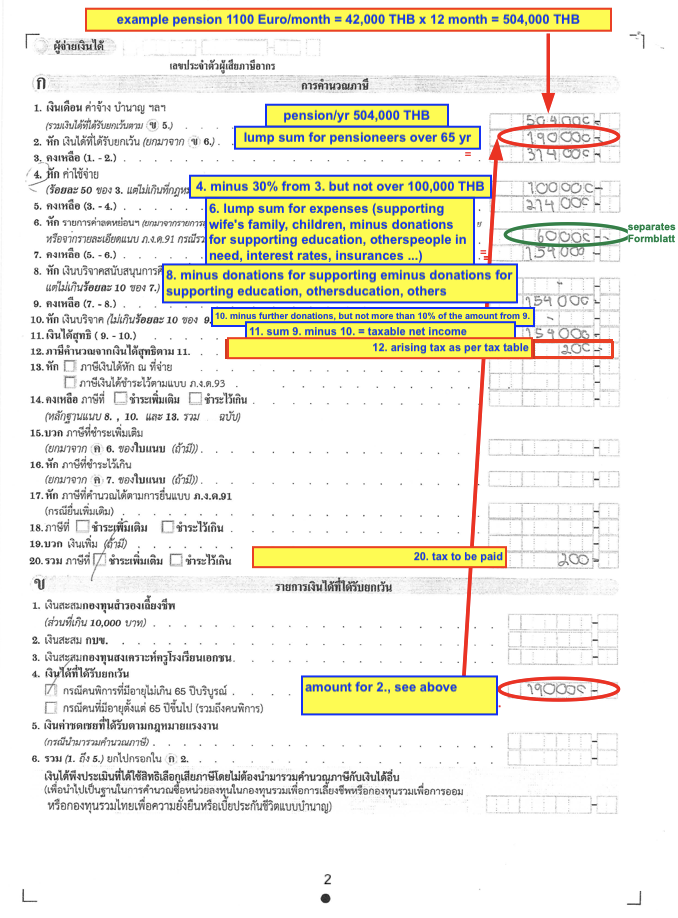
- You will use Thai tax return form number 91, which is in Thai script and typically requires assistance to complete. After entering your annual income (in this case, your pension), you first deduct allowable expenses, just like in your home country’s tax return process.
Below is an example of a foreign pensioner who, alongside the author of this article, went through the individual steps with a helpful and knowledgeable official responsible for foreign income taxation at the local tax office.
In this example, only flat-rate deductions (tax allowances) were applied, as the pensioner had no additional deductible expenses.
It’s important to be familiar with these steps, as they have rarely been addressed in previous publications.
Key Points:
A foreign pensioner can claim deductions using standard lump sums and actual payments, which then result in a final tax amount. In some cases, this could even lead to a tax credit, similar to how deductions work in many home countries.
Example Calculation Based on Euros for Taxation in Thailand:
The pensioner receives a net income of €1,100 per month, which is approximately 42,000 THB/month, or around 504,000 THB/year.
The taxation is as follows: Below are copies of the calculation explained by the official, along with personal comments.
Here is page 2 of the tax return:
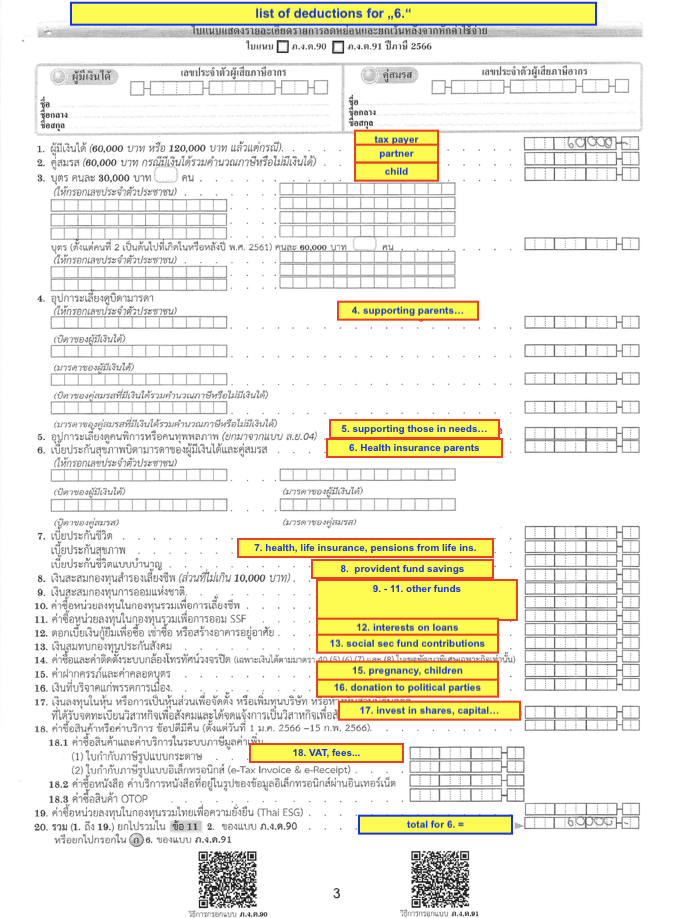
Followed by page 3, which mainly deals with the possible deductions:
See here the calculation (by Excel) for a better overview:
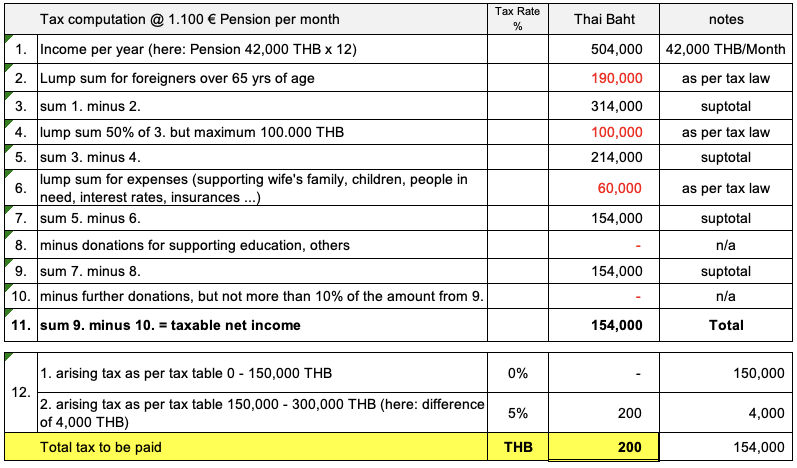
In summary, a foreign taxpayer with a monthly pension income of €1,100, or €13,200 per year (equivalent to 504,000 THB), would pay approximately 200 Thai Baht in taxes.
You can replace the 504,000 THB with your own annual pension income and apply the standard deductions provided to estimate your tax burden. The steps for calculating individual taxes can be found under point 12, using the progressive tax table.
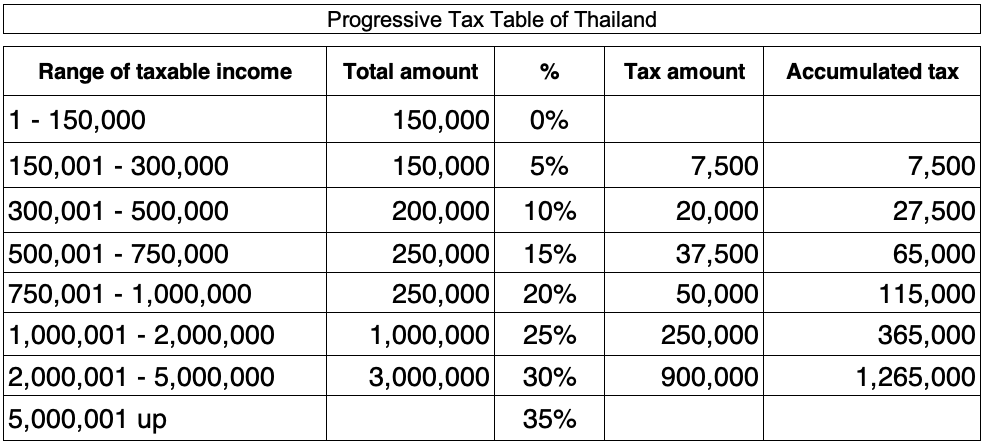
To illustrate for those with higher pensions, here is a calculation for a monthly pension income of €2,500, which amounts to €30,000 per year, or 95,000 THB per month, and 1,140,000 THB per year:

It’s important to note that both examples use only deductible lump sums. However, you will likely have additional expenses, such as health insurance and other types of insurance, which can be deducted as outlined in point 6 of the list of deductions. Health insurance in Thailand alone costs between 100,000 THB and 300,000 THB or more per year, depending on your age and coverage. Additionally, if you support your Thai partner’s family or make charitable donations, these expenses are also deductible.
In summary:
- Even if the taxation of foreign income is implemented as currently planned, the tax payments will remain moderate. Those with lower pension incomes will face minimal tax burdens, similar to those with higher pensions.
- The tax system, though somewhat new, is being implemented with the goal of creating a manageable framework. Much of the implementation details are still open, and it is likely that there will be adjustments that will be workable.
- Patience is key; it will take some time before the situation is fully clarified.
- Avoid taking any action until more information is available. Don’t apply for a tax number at the Revenue Department until you have more clarity. Consulting a tax advisor now is premature and may be a waste of time and resources.
- Be skeptical of sensational headlines in the media. Reputable sources tend to be cautious in their statements, while tabloids and some TV stations often spread incomplete or misleading information.
- Critically evaluate video content from so-called influencers on platforms like YouTube. While they may have previously provided valuable insights about Thailand, many now focus on sensationalism to increase their followers and revenue.
- If you follow someone on YouTube or Facebook regarding tax matters, compare their reports with other sources to determine who provides more reliable information.
I regularly review and objectively assess information on this topic, seeking advice from trusted experts. Feel free to contact me if you need updates or have questions – I’m here to help.
Best regards
Michael
Phone: +66 61 525 96 46
E-Mail: michael@immo-th.com


